Sector · Construction & technical trades
Skilled crews from India for Greek construction sites
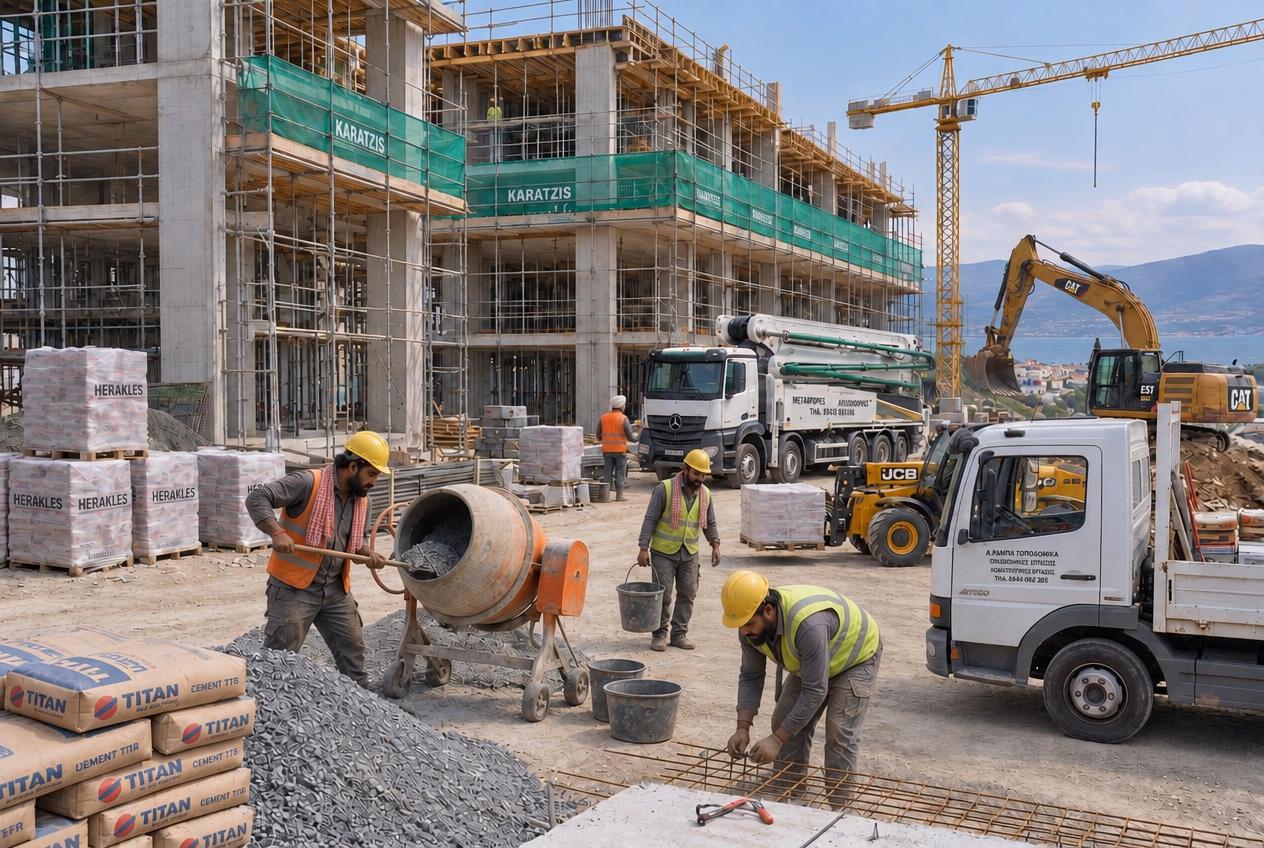
From the structural frame to the final coat of paint — we source steel fixers, formwork carpenters, concrete workers and finishing trades for private and public projects, and prepare each file in line with the e-EFKA registration, ERGANI and site-safety rules.
31,707
building permits issued in Greece in twelve months (ELSTAT, 07/2025–06/2026)
≈210,000
people employed in the Greek construction sector (IOBE, 2024)
4–7 months
typical time from the first request to a worker's arrival on site
Figures from the public sources listed at the bottom of the page.
Positions we fill
No technical vocabulary needed — just tell us what happens on your site. These are the profiles we are asked for most often.
Concrete worker
- Receiving concrete from pump or truck
- Compacting with vibrator and screed
- Finishing the slab and keeping it wet while it cures
Steel fixer
- Preparing steel to the structural design
- Assembling cages for foundations, columns and slabs
- Checking spacing and cover before the pour
Formwork carpenter
- Building shuttering in timber or system formwork
- Bracing, levelling and checking before concrete
- Dismantling and preparing for the next floor
Tiler
- Indoor and outdoor tiling
- Sealing bathrooms and kitchens before laying
- Clean finish with joints, cuts and edging
General construction labourer
- Keeping crews supplied with materials and tools
- Helping during pours and formwork removal
- Digging, backfilling and keeping the site tidy
Painter
- Preparing and smoothing surfaces
- Base and top coats inside and outside
- Protective coatings on wood and steel
Mason & plasterer
- Building walls and partitions
- Three-coat render, inside and out
- Setting profiles for straight corners and surfaces
Electrician / HVAC technician
- First-fix conduit and cabling
- Second-fix work supervised by a licensed installer
- Air-conditioning units and refrigerant lines
The work is there. The hands are not.
A site moves only as fast as its crews. No rebar or formwork means the pour waits; no finishing trades means handover slips.
And the pipeline is growing. ELSTAT recorded 31,707 building permits in the twelve months from July 2025 to June 2026, up 10.1% year on year. IOBE puts sector employment at about 210,000 people in 2024, with around €10 billion of infrastructure planned for 2027–2030.
The 2026 quota lists frame and finishing trades by name. That is exactly where VresErgati's network in India is focused.
Which phase do we start with?
The best request is not the longest — it is the one that tells us when people join the project and what they must already know.
01
Load-bearing structure
Formwork, rebar, concrete. Useful for us: which formwork system you use, and whether the steel fixer will work from the drawings alone or under guidance.
02
Finishes
Masonry, render, tiles, paint, insulation. Name your materials — external insulation, drywall and so on — so we can screen for matching experience.
03
M&E works
Electricians and refrigeration technicians have their own line in the quota, so they are planned separately.
Set a level for each position: craftsman, assistant or unskilled. This distinction from the sector agreement also sets the daily wage. And plan for a crew leader who will show newcomers your way of working during the first weeks.
Two routes to your site
The standard route: quota and E.4 permit
Because building work is not treated as seasonal, workers arrive on a residence permit for dependent employment (E.4). For 2026, Act 35/2025 makes 4,900 places available — 4,500 for construction workers, 300 for electricians, 100 for refrigeration technicians — as one pool for the whole country. Contracts last at least 6 months, at no less than the statutory craftsman's daily wage.
The special route: public or strategic projects
Contractors on public works (Law 4412/2016) and strategic investments can use Article 61(7) of the Migration Code: up to 500 people per project, not counted against the quota, with faster review. It requires a certificate from the supervising ministry that confirms the project and names the workers.
The right moment to start
In farming the season decides; in construction the project schedule does. The file should open when the contract is signed or the permit is issued — not when the site is already waiting.
On paper the authorities have 90 days from a complete application. In reality, getting a worker on site takes somewhere between 4 and 7 months overall. Our rule of thumb: start at least half a year before the target phase. The Act for 2027 is due in the last quarter of 2026; until then Act 35/2025 applies.
How we start working together
Three simple steps — and the first two cost you nothing:
01
Contact form
Fill in the contact form here on our website and tell us briefly what your project needs.
02
Workforce Request
You then complete our Workforce Request form. Based on it, we check with our partner in India whether — and how fast — we can source the people you are looking for. This step is free of charge and non-binding.
03
Cooperation contract
If the capacity and the professional requirements check out, we prepare a cooperation contract. Only then does the actual sourcing begin.
For the file itself we will then typically need from you:
- 1A short outline of the request: which trades, at what level, how many people, where and from when.
- 2Company documents from GEMI (articles, general certificate, representation) and the legal representative's ID.
- 3Financials — tax return and E3 — since the current ministerial decision links the number of places to company revenue.
- 4Proof that the trades fit your business, e.g. activity codes, construction contracts or building permits.
- 5For a public project outside the quota, the relevant ministry certificate.
- 6Your plan for accommodation and daily transport to the site.
Legal documents — contract, solemn declarations — are drafted by our legal partner. We keep the coordination from start to arrival.
The framework at a glance
A short overview of the obligations. We agree the concrete steps together before signing.
AMOE before the first trowel
The project is declared to e-EFKA and gets an AMOE number before any work. The construction APD then follows every month.
E12 in ERGANI
The digital work card does not cover construction projects. Employment is declared with form E12 — daily on technical projects, monthly on private buildings.
Bonuses via the holiday stamp
You do not pay bonuses and holiday allowance directly; e-EFKA pays them from the APD contributions into the worker's IBAN account.
Site safety
Safety plan and file under P.D. 305/1996, a measures log where required, and an appointed safety technician. Instructions must be given in a language the crew understands.
Pay
The floor is the statutory daily wage. If your company belongs to PEDMEDE, SATE or STEAT, the construction sector agreement applies as well.
Frequently asked questions
Must I arrange accommodation?
The law does not generally require it for dependent employment — that duty mainly concerns seasonal farm work. Still, someone who has just landed in Greece has nowhere to stay, and many sites are outside town. We suggest solving it before arrival and writing it into the contract: type of housing, location and any contribution from the worker.
Does the sector agreement cover workers from India too?
Nationality plays no role. Where your company is bound by the construction agreement, the same terms apply to all staff — and the craftsman / assistant / unskilled grading sets the daily wage.
Can an electrician from abroad sign off installations?
Not from day one. Electrical and refrigeration work requires a licence issued by the Region after exams, and foreign titles are not valid automatically. Until then they work in the crew of a licensed installer, who carries the responsibility.
How are bonuses paid?
Through the same mechanism as for any construction worker: you pay the holiday stamp via the APD and e-EFKA pays the worker three times a year — Easter, summer, Christmas. We help make sure the worker has an IBAN registered early.
What happens in a heatwave?
In extreme temperatures the Ministry of Labour can make outdoor work stop for set hours and areas. Leave some slack in your summer programme.
This information is for guidance only and is not legal or accounting advice. The framework changes often — only the signed contract is binding.
Public sources
- · ELSTAT — Building activity survey, July 2025–June 2026
- · IOBE — Business surveys, May 2026; study on construction for TEE (June 2025)
- · Council of Ministers Act 35/2025 (Gov. Gazette A 241/29.12.2025) — 2026 quota
- · Article 61 of Law 5038/2023 (Migration Code), as amended by Law 5275/2026
- · Ministry of Labour circular 25291/23.9.2026 on the digital work card
- · Construction workers collective agreement of 26.2.2025
- · e-EFKA — construction project registration and APD
- · Ministry of Labour — ERGANI, form E12
- · Presidential Decree 305/1996 on construction-site safety